
Overview
How I scaled a competitive education market campaign from stable baseline to consistent high performance, managing ₹231K budget across multiple channels with 36.9K clicks and 4.75% CTR.

THE CHALLENGE
CLIENT PROFILE:
Education & placement institute offering:
– Professional certification courses
– Skill development programs
– Job placement services
– Career counseling
MARKET CHALLENGES:
– Highly competitive (100+ education institutes in target market)
– Multiple audience segments (students, working professionals, career changers)
– Long consideration cycle (15-30 days from lead to enrollment)
BASELINE SITUATION (Early February 2026):
– Monthly budget: ₹231K
– Monthly clicks: 36.9K
– CTR: 4.75%
– Form submissions: ~178
THE GOAL:
Scale qualified leads while maintaining cost efficiency and lead quality
Deeper Diagnosis
What I found:
Before optimizing, I diagnosed the current situation
Problem 1: Multiple Audience Segments, One Campaign
– Students (looking for skill development)
– Working professionals (looking for career advancement)
– Career changers (looking for new direction)
– All lumped into one campaign = Poor relevance
Problem 2: Multiple Course Offerings, One Message
– IT certifications (Java, Python)
– Data Analytics/ Data Science (high demand, high conversion)
All with same ad copy = Inefficient
Problem 3: Campaign Structure Issues
– Keywords too broad (“courses”, “jobs”, “training”)
THE STRATEGY
MY APPROACH
1: Audience Segmentation
Instead of one audience, I created three:
Segment A: Students
– Interest: Skill development + job placement
– Pain point: Unemployment/career confusion
– Message angle: “Launch your tech career in 3 months”
– Messaging: Success stories, placement rates, salary outcomes
– Budget: 60%
Segment B: Working Professionals
– Interest: Career advancement + salary increase
– Pain point: Career plateau/stagnation
– Message angle: “Get promoted. Get paid more.”
– Messaging: Industry-relevant skills, certification value, ROI
– Budget: 20%
Segment C: Career Changers
– Interest: Career change + stability
– Pain point: Job insecurity/dissatisfaction
– Message angle: “Start fresh in tech. Secure income.”
– Messaging: Success stories of career pivots, placement support
– Budget: 20%
2: Course-Specific Campaigns
Instead of generic ‘courses’, I segmented by course type
High-Demand Courses (70% of budget):
– Data Analytics (highest ROI)
Lower-Demand Courses (20% of budget):
-Full Stack Courses (Java, Python)
3: Landing Page & Form Optimization
Minimized friction, maximized quality
Form Fields:
– Students: Name, email, phone, course interest, experience level
– Professionals: Name, email, phone, current job, salary expectation
– Career changers: Name, email, phone, current field, motivation
Landing Pages:
– Data Analytics: ROI-focused, salary data, job postings
– Full-Stack: Portfolio building, job market overview, learning path
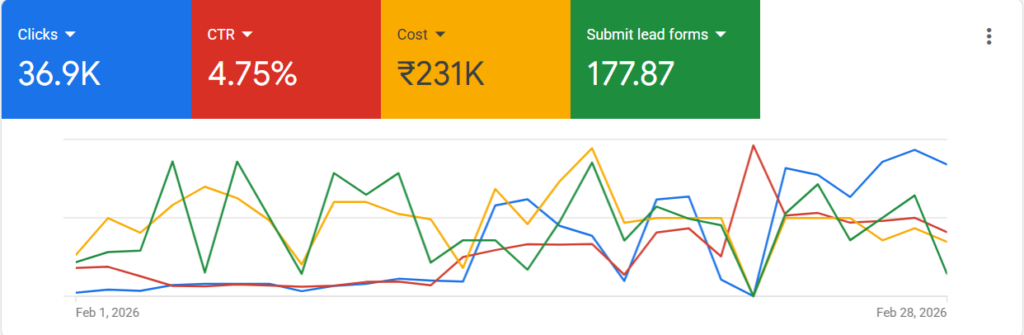
THE RESULTS
VOLUME & ENGAGEMENT:
– Clicks: 36.9K
– CTR: 4.75% (excellent — industry average 2-3%)
– Cost: ₹231K
– Cost per click: ₹6.26
LEAD QUALITY:
– Form submissions: ~178
– CPL (Form): ₹1298
– Quality distribution:
* High-quality: 60%
* Medium-quality: 20%
* Low-quality: 20%
KEY INSIGHTS
1: Audience Segmentation Transforms Results
By segmenting into students, professionals, and career changers, each group responded to different messaging. Result: Better CTR (4.75%), better lead quality, better conversions.
2: Course-Specific Campaigns Beat Generic
Instead of ‘enroll in a course’, targeting specific courses works better.
Result: Better spend allocation, higher average revenue per lead.
3: Lead Quality Matters More Than Volume
We had 36.9K clicks, but what mattered was:
– How many were genuinely interested (form completion)
– How many qualified
– How many converted to enrollments
100 high-quality leads beats 500 low-quality leads
CONCLUSION:
Education marketing requires more than just scaling ads. It requires understanding different student personas, communicating benefits that matter to each, and nurturing through a long decision cycle. With strategic segmentation and data-driven optimization, you can fill classrooms profitably and sustainably.